Showing posts with label confirmation. Show all posts

Tuesday, April 10, 2012

Change We Mistakenly Believe In

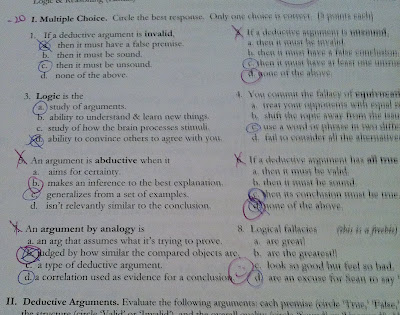
Here's a common example of confirmation bias and selective memory most of us have experienced:  do you think we should stick with our first instinct when answering a test question?  Most of us think we should.  After all, so many of us remember lots of times where we initially circled the right answer, only to cross it out and choose another.

The problem with this is that research suggests that our first instincts are no more reliable than our second-guessing.  Why does the myth persist?  Well, we're more likely to remember the times we second-guessed and got it wrong than the times we second-guessed and got it right.  Switching away from the right answer is just so frustrating that it's a more memorable event.  So if I got back the following test...

Overthinking: Not a Thing
...I'd probably only notice that I changed #6 and #7 to the wrong answer.  I'd be much less likely to notice that I changed #1 and #3 to the right answer.
The Conspiracy Bug

Here's an article on a 9/11 conspiracy physicist that brings up a number of issues we're discussing in class (specifically appealing to authority and confirmation bias). I've quoted an excerpt of the relevant section on the lone-wolf semi-expert (physicist) versus the overwhelming consensus of more relevant experts (structural engineers):

While there are a handful of Web sites that seek to debunk the claims of Mr. Jones and others in the movement, most mainstream scientists, in fact, have not seen fit to engage them.

"There's nothing to debunk," says Zdenek P. Bazant, a professor of civil and environmental engineering at Northwestern University and the author of the first peer-reviewed paper on the World Trade Center collapses.

"It's a non-issue," says Sivaraj Shyam-Sunder, a lead investigator for the National Institute of Standards and Technology's study of the collapses.

Ross B. Corotis, a professor of civil engineering at the University of Colorado at Boulder and a member of the editorial board at the journal Structural Safety, says that most engineers are pretty settled on what happened at the World Trade Center. "There's not really disagreement as to what happened for 99 percent of the details," he says.
And one more excerpt on reasons to be skeptical of conspiracy theories in general:
One of the most common intuitive problems people have with conspiracy theories is that they require positing such complicated webs of secret actions. If the twin towers fell in a carefully orchestrated demolition shortly after being hit by planes, who set the charges? Who did the planning? And how could hundreds, if not thousands of people complicit in the murder of their own countrymen keep quiet? Usually, Occam's razor intervenes.

Another common problem with conspiracy theories is that they tend to impute cartoonish motives to "them" — the elites who operate in the shadows. The end result often feels like a heavily plotted movie whose characters do not ring true.

Then there are other cognitive Do Not Enter signs: When history ceases to resemble a train of conflicts and ambiguities and becomes instead a series of disinformation campaigns, you sense that a basic self-correcting mechanism of thought has been disabled. A bridge is out, and paranoia yawns below.
There are  a lot of graduate-educated young earth creationists.

Monday, April 9, 2012

Rationalizing Away from the Truth

A big worry that the confirmation and disconfirmation biases raise is the difficulty of figuring out what counts as successful, open-minded reasoning, versus what amounts to after-the-fact rationalization of preexisting beliefs. Here are some links on our tendency to rationalize rather than reason: